

A past-producing, high-grade gold mine on Nova Scotia's South Shore. Recent drilling and sampling show the gold system extends well beyond the historic workings, with several promising targets yet to be tested.
Blockhouse is a past-producing, high-grade gold mine on Nova Scotia's South Shore. In January 2017, seven NQ diamond drill holes totalling 644 metres were completed from three sites around the historic Prest workings. The standout hole, BH-17-01, intersected 1.06 g/t Au over 10.25 m from 36.0 m in a bedding-parallel fault zone of quartz veining with visible gold, including vein samples of 25.7 g/t and 12.1 g/t Au, and BH-17-07 returned 1.49 g/t Au over 1.8 m. The BH-17-01 zone points to a second style of target at Blockhouse: bedding-parallel faults that offset the Prest Vein. Several similar faults are mapped on historic plans of the property and have not yet been drill-tested. Next-phase work will target a continuous mineralized system potentially extending along strike within the Blockhouse anticline, the key structure controlling mineralization at the property.
| Hole | Easting | Northing | Azimuth | Dip | Length (m) | Best gold results |
|---|---|---|---|---|---|---|
| BH-17-01 | 386883 | 4921246 | 340° | -55° | 146 | 1.06 g/t Au over 10.25 m (36.0-46.25 m), incl. 25.7 g/t and 12.1 g/t Au in quartz veins with visible gold |
| BH-17-02 | 386883 | 4921246 | 80° | -45° | 38 | 0.24 g/t Au over 1.0 m (17.0-18.0 m) |
| BH-17-03 | 386880 | 4921246 | 80° | -90° | 137 | 1.33 g/t Au over 0.5 m (92.8-93.3 m) in a quartz vein |
| BH-17-04 | 386857 | 4921367 | 45° | -45° | 65 | 0.27 g/t Au in a quartz vein at 41.0 m |
| BH-17-05 | 386763 | 4921431 | 340° | -45° | 80 | No significant gold |
| BH-17-06 | 386873 | 4921242 | 80° | -90° | 119 | 0.52 g/t Au over 1.4 m (82.8-84.2 m); 0.57 g/t Au over 0.45 m (110.4-110.85 m) |
| BH-17-07 | 386889 | 4921273 | 280° | -70° | 59 | 1.49 g/t Au over 1.8 m (38.0-39.8 m), incl. 2.08 g/t Au over 1.0 m |
| Total | 644 |
Coordinates are UTM NAD83 Zone 20N, located by handheld GPS. Intervals are core lengths. Results are from Actlabs certificates A17-01077 and A17-01783, as reported in MacKay (2017, revised June 9, 2017), the assessment report for exploration licence 50564.
Location
The Blockhouse Property is located in Lunenburg County, Nova Scotia, roughly 4 km west of the town of Mahone Bay and about 70 km west-southwest of Halifax. Access is excellent: the property is reached via Mines Road off Highway 325, and Highway 103 passes near its northwest corner. Secondary roads reach most of the property directly from the highway.
Geology
Blockhouse lies within the Meguma Supergroup, the host of most of Nova Scotia's historic gold production. The property straddles the northeast-trending Blockhouse anticline, where quartzites and greywackes of the Goldenville Group meet the overlying slates of the Halifax Group.
Gold occurs in quartz fissure veins that cut across the south flank of the anticline, most notably the Prest Vein. The richest historic ore came from where the Prest Vein crosses a 25 m thick, sulphide-rich slate unit known as the "favourable horizon", a zone called the Prest Shoot. Recent drilling has shown that bedding-parallel faults offsetting the Prest Vein can also host broad zones of gold-bearing quartz veining, opening a second style of target on the property.
History
Blockhouse is a past-producing gold mine. Underground work on the Prest Vein ran from the late 1800s into the early 1930s, with sporadic activity into the mid-1950s. Total reported historical production is 3,588 oz of gold from 6,210 tons of ore, an average of 0.58 oz/ton.
The Prest Shoot alone produced 3,259 oz of gold from 2,043 tons of mill feed between 1896 and 1935, an average historical grade of 1.59 oz/ton (49.6 g/t). The vein was stoped over about 300 m of strike to a depth of 60 m, with drifting at the 90 m level. Sampling of the 60 m level in the late 1930s traced the Prest Shoot for 138 m, averaging 0.37 oz/ton over 0.35 m.
Key modern work:
- 1982-1983: Ten diamond drill holes tested near-surface potential, alongside magnetometer and VLF surveys.
- 2016: An induced polarization (IP) and resistivity survey over the old workings outlined two well-defined, steeply dipping chargeability trends, each 5-10 m wide and extending past 68 m depth. Neither had previously been drilled, and both were rated high-priority targets. The same year, a selected sample from the historic muck piles at the old mine site returned 494 g/t Au (21Alpha, 2016).
- January 2017: Seven diamond drill holes (644 m) were completed with support from a $60,000 Nova Scotia shared-funding grant. Hole BH-17-01 intersected 1.06 g/t Au over 10.25 m from 36.0 m, in a zone of quartz veining with visible gold. Individual vein samples within the zone returned 12.1 g/t, 7.08 g/t and 22.0 g/t Au (25.7 g/t by metallic screen fire assay). The program geologist described the intercept as a significant discovery, with its full extent still untested (MacKay, 2017).
- 2018: During a humus geochemical sampling program, quartz vein float with visible gold was found about 700 m south of the old workings. A sample of this float assayed 77 g/t Au (AGAT certificate 18T360617), and its source has not yet been followed up. Humus samples in the same area outlined a northeast-trending gold anomaly (21Alpha, 2018).
Exploration Plans
Our geologists are currently finalizing exploration plans that will take place over the course of the fall and winter months using a combination of soil geochemistry and geophysical methods. The open BH-17-01 zone, the untested IP trends, the extension of the Prest Shoot beyond the historic workings, and the source of the 77 g/t Au float 700 m to the south offer multiple compelling targets for follow-up.
Gallery
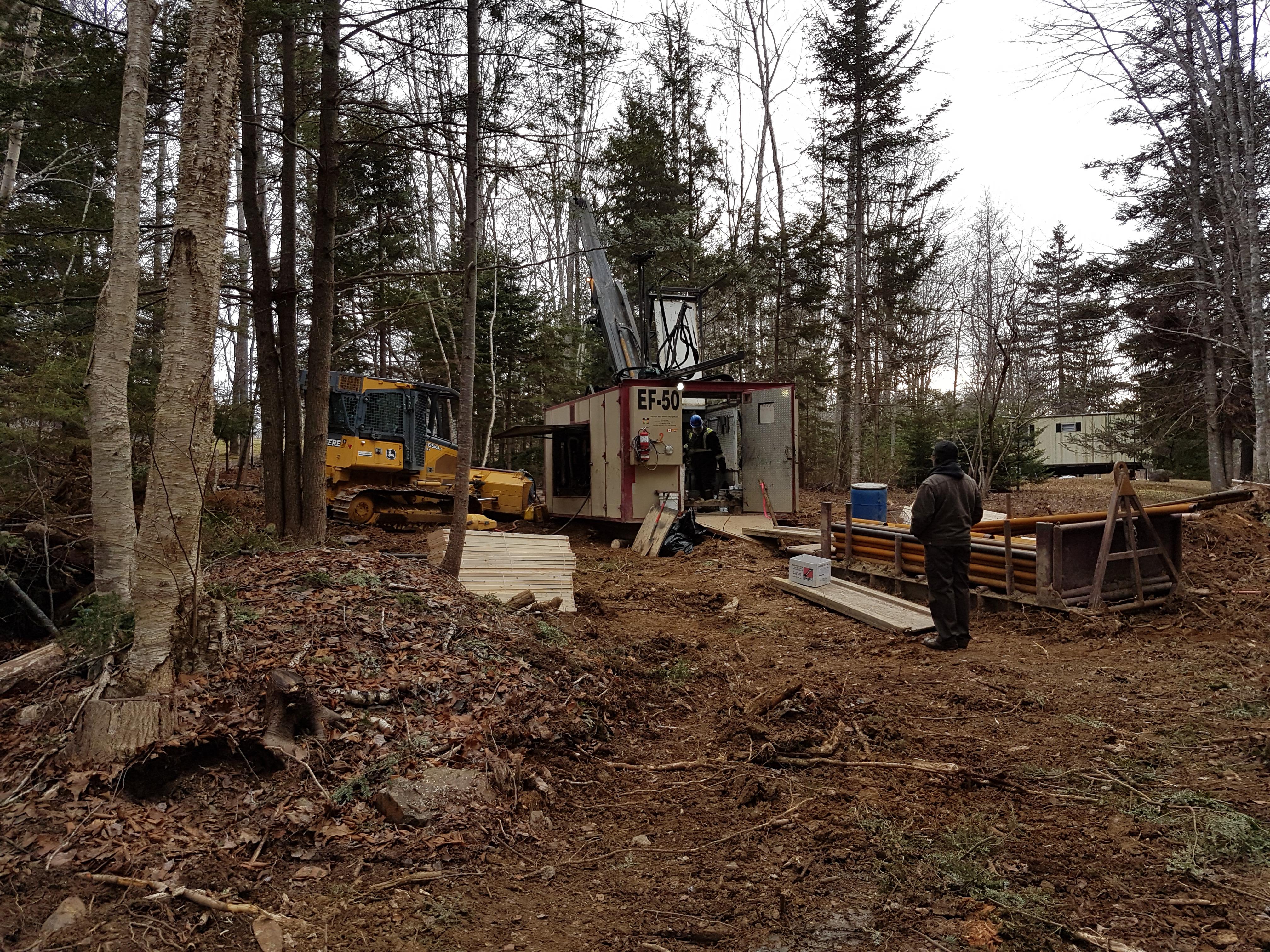
2017 drill pad at Blockhouse 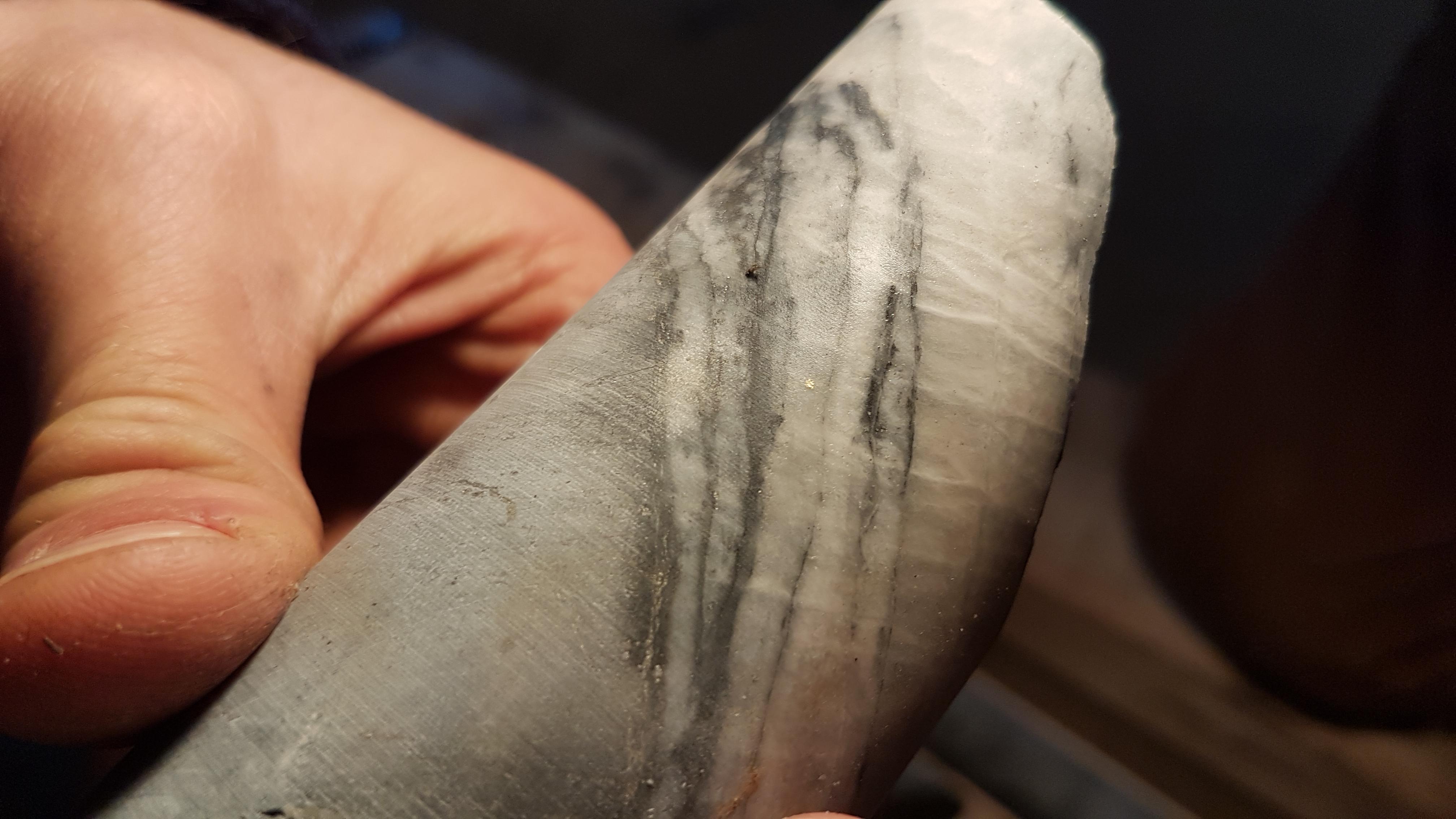
Visual gold at Blockhouse in quartz vein. 2017 drill program.
Forward-Looking Statements
All statements on this website about anticipated future events or results constitute forward-looking statements, including, but not limited to, statements with respect to the Company's exploration plans, the potential of its mineral properties, financings and the use of proceeds, and the timing and results of future exploration programs. Forward-looking statements are often, but not always, identified by the use of words such as “seek”, “anticipate”, “believe”, “plan”, “estimate”, “expect” and “intend” and statements that an event or result “may”, “will”, “should”, “could” or “might” occur or be achieved and other similar expressions. Although Freedom Gold Corp. (“Freedom” or the “Company”) believes that the expectations reflected in such forward-looking statements are reasonable, undue reliance should not be placed on them since the Company can give no assurance that such expectations will prove to be correct. These statements involve known and unknown risks, uncertainties and other factors that may cause actual results or events to differ materially from those anticipated, including risks associated with the business of Freedom; risks related to exploration and potential development of the Company's mineral properties; business and economic conditions in the mining industry generally; fluctuations in commodity prices and currency exchange rates; uncertainties relating to interpretation of drill results and the geology, continuity and grade of mineral deposits; the need for cooperation of government agencies and First Nation groups and the issuance of required permits; the need to obtain additional financing and uncertainty as to its availability and terms; the possibility of delay in exploration or development programs; and other risk factors identified in Freedom's filings with Canadian securities regulators on SEDAR+. Forward-looking statements are based on estimates and opinions of management at the date the statements are made. Freedom does not undertake any obligation to update forward-looking statements except as required by applicable securities laws.
Historical exploration results referenced on this website have not been independently verified by the Company and should not be relied upon. Technical information on this website has been reviewed and approved by Mr. Martin Demers, P.Geo. (APEGNB L5980), a technical advisor to the Company and a Qualified Person as defined by National Instrument 43-101.
The Canadian Securities Exchange has not reviewed and does not accept responsibility for the adequacy or accuracy of the content of this website.